

Essential camera gear for landscape photography: What’s actually worth buying?

Landscape photography captures the beauty of natural scenes, from vast mountain vistas to intimate forest details. While skill and timing are the foundation of great photography, the right gear helps you create sharp, high-quality images in challenging outdoor conditions like low light, high wind, or rugged terrain.
You don’t need a massive bag of gear to capture great landscapes. You need a setup that allows you to handle low light, wind, and distance.
Why gear choice matters in landscape photography
Landscape photography often involves tripod-based shooting at dawn or dusk, managing extreme dynamic range, and hiking to remote, off-the-grid locations. But, it is often as much about the journey as the shot. Whether it’s a grueling climb to a mountain peak or a quiet morning in the woods, your gear needs to be reliable. When choosing your kit, prioritize these four pillars:
- High resolution and dynamic range: Essential for large-format printing and pulling shadow detail from RAW files.
- Weather sealing: Reliability is non-negotiable when shooting in rain, dust, or humidity.
- Weight and portability: Your gear must be comfortable enough to carry on long-distance hikes.
- Lens versatility: Covering the spectrum from ultra-wide to telephoto is critical for varied compositions.
Best cameras for landscape photography
Modern mirrorless cameras are the standard for landscape work in 2026, offering superior dynamic range, high resolution, reliable weather sealing, and in-body image stabilization (IBIS).
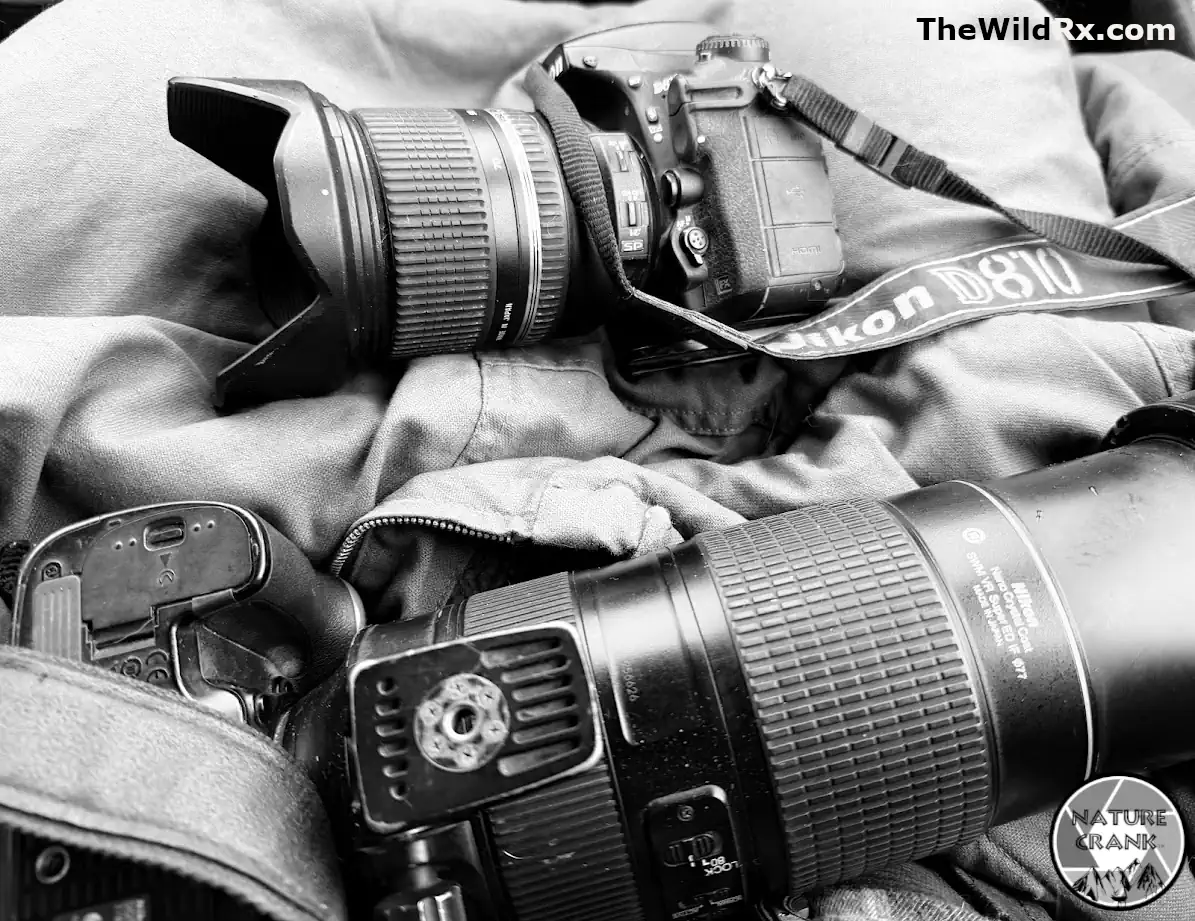
For most landscape shooters, a full-frame mirrorless camera in the 40-60MP range is the sweet spot. It provides enough detail for gallery-sized prints without the bulk or price tag of medium format. While I personally still rely on my Nikon D810 for its stunning dynamic range, newer mirrorless models offer significant weight savings and stabilization improvements that are game-changers for hiking.
Top recommendations for 2026
You can click the manufacturer’s links below. I’ve curated my top picks in my Amazon Storefront for easy access. Clicking these links helps support this site at no extra cost to you.
| Camera type | Recommended models | Why it’s ideal for landscape |
| Medium format | Fujifilm GFX 100S II | Delivers unmatched 102MP resolution and 16-bit color depth, providing the most latitude for massive gallery prints and complex shadow recovery. |
| Full-frame (High res) | Nikon Z8 | A “mini-flagship” that offers 45.7MP detail and a rugged, fully weather-sealed body without the excessive bulk of a built-in vertical grip. |
| Full-frame (High res) | Sony A7R V | Features an industry-leading 61MP sensor and a unique 4-axis multi-angle screen that is perfect for low-angle vertical compositions. |
| Full-frame (Balanced) | Nikon Zf | Combines a classic aesthetic with modern tech, including Pixel Shift for 96MP files and a dedicated B&W switch for pre-visualizing textures. |
| Full-frame (Balanced) | Sony A7 IV | The definitive “all-rounder” with a 33MP sensor that hits the sweet spot between high detail and manageable file sizes for most hobbyists. |
Note: Avoid prioritizing high-speed burst rates or complex video features; landscape photography rarely demands these capabilities.
Budget landscape options: Quality without the price tag
You don’t need the latest mirrorless flagship to capture world-class landscapes. In 2026, the used DSLR market is literally a goldmine for landscape photographers. Cameras like the Nikon D3500 and Nikon D7500 are workhorses that still produce stunning 24MP and 20MP files, respectively.
- Nikon D3500: The ultimate “light and lean” budget pick. It lacks weather sealing, but its sensor is incredibly capable in good light, and its battery life is legendary. It’s perfect if you are just starting and want to prioritize weight.
- Nikon D7500: This is the “prosumer” sweet spot. It offers better weather sealing than the D3500, a tilting touchscreen (vital for low-angle shots), and a much more robust build. It’s a camera that grows with you as your skills evolve.
What’s in my bag: My personal landscape setup
While mirrorless is the future, my current kit is proof that “older” DSLR gear is still incredibly relevant. I rely on a mix of full-frame resolution and crop-sensor versatility.
My camera bodies
- Nikon D810: This is my primary workhorse. Its 36.3MP sensor and base ISO of 64 provide a level of dynamic range that is still hard to beat in 2026. It is my go-to for grand vistas where I need maximum detail and “crop-ability.”
- Nikon D7200: I use this as my secondary body or when I need a bit more “reach” thanks to the 1.5x crop factor. It’s a rugged, reliable backup that handles the elements beautifully.
My go-to glass
I keep my lens kit simple and high-performing, focusing on two lenses that cover almost every scenario I encounter. This is not to say I don’t use my many other lenses but these lenses specifically stay on my cameras at all times.
- Tamron 24-70mm f/2.8 G2: This is my “walking around” lens. It’s sharp, stabilized, and covers the perfect range for everything from foreground-heavy wide shots to standard-view portraits of the landscape. The best part is that it is a fraction of the cost of Nikon delivering stunning results.
- Nikon 70-200mm f/2.8: Essential for isolating distant peaks or compressing layers of forest. Even though it’s heavy, the optical quality is worth every gram when the light hits a distant ridgeline.
DSLR vs. mirrorless: The 2026 landscape perspective
Deciding whether to stick with a classic DSLR (like my D810) or move to a modern mirrorless system (like the Nikon Z-series) comes down to your priorities in the field. Here is how they stack up for landscape-specific work:
| Feature | DSLR (e.g., Nikon D810) | Mirrorless (e.g., Nikon Z8) | Why it matters for landscapes |
| Battery life | Excellent: 1,200+ shots per charge. | Moderate: ~350–500 shots per charge. | Vital for multi-day backpacking trips with no power. |
| Viewfinder | Optical: Zero lag; works even when the camera is off. | Electronic: Real-time exposure preview and “live” histogram. | EVFs let you see exactly how the sky will look before you shoot. |
| Autofocus | Fast for stills, but struggles in Live View. | Advanced AI tracking and 400+ focus points. | Mirrorless is superior for “focus stacking” and low-light focus. |
| Stabilization | Lens-based only (VR). | In-body (IBIS): Up to 6 stops of stabilization. | Allows for sharp handheld shots in low light during a hike. |
| Weight | Heavier, more robust bodies. | Lighter, more compact bodies. | Every gram counts when you’re climbing 1,000+ feet of elevation. |
| Lens options | Huge used market; very affordable. | Newer “S-Line” lenses are sharper but more expensive. | DSLR glass offers the best “bang for your buck” in 2026. |
The bottom line
If you are on a budget or spend days away from a charging port, a DSLR is a powerhouse. However, if you want the sharpest modern glass and a camera that shows you the finished exposure before you even click the shutter, mirrorless is the way to go. I’d personally switch in a heartbeat but they’re way out of my budget range!
Essential lenses: wide-angle vs. telephoto
Lenses are more critical to your creative output than the camera body itself. A common, effective kit consists of one ultra-wide zoom and one telephoto zoom, covering 80–90% of all landscape scenarios.
While a wide-angle lens helps you capture grand scale, the true impact comes from how you arrange your subjects. Once you have the right glass in your bag, check out my guide on Mastering landscape photography composition to learn how to turn that gear into a compelling image.
Wide-angle lenses (14-35mm range)
These are essential for capturing expansive scenes, foreground interest, and dramatic skies. They emphasize scale and leading lines, immersing the viewer in the landscape.
- Pro-tip: Choose f/4 versions of wide-angle zooms if you prioritize weight savings. At typical landscape apertures of f/8 to f/11, they are just as sharp as their f/2.8 counterparts.
| Camera pair | Recommended lens | Why it’s a good “hiking” choice |
| Nikon Z8 / Zf | Nikon Z 14-30mm f/4 S | Weighs only 485g. Its retractable design makes it incredibly compact, and unlike many ultra-wides, it has a flat front element that accepts standard 82mm filters. |
| Sony A7R V / A7 IV | Sony FE 16-35mm f/4 G PZ | At just 353g, it’s one of the lightest full-frame wide zooms ever made. It uses internal zooming, so the lens doesn’t change length—great for balance on a tripod. |
| Sony (Extreme wide) | Sony FE 12-24mm f/4 G | For those who need a wider field of view than 16mm. It’s heavier than the 16-35mm but still much lighter than the f/2.8 GM version. |
Telephoto lenses (70-200mm+)
Telephoto lenses allow you to compress distance, isolate specific details, and create abstract patterns. They are invaluable for “stacking” layers of mountains or focusing on isolated elements like waterfalls or ridgelines.
| Lens model | Best for | Why it’s a good choice |
| Sony FE 70-200mm f/4 Macro G OSS II | Versatility & detail | This is a “dual-purpose” lens. Not only is it incredibly sharp at 200mm, but it features 0.5x macro capability, allowing you to switch from mountain vistas to intimate flower or ice details without changing glass. |
| Nikon Z 70-180mm f/2.8 | Low light & weight | While technically $f/2.8$, this lens is designed for the weight-conscious. It is significantly lighter and smaller than “pro” 70-200mm zooms, making it the perfect compromise for Nikon shooters who want a faster aperture for blue-hour shots. |
| Tamron 70-300mm f/4.5-6.3 Di III RXD | The minimalist hiker | At just 545g, this is the ultimate “just in case” telephoto. It’s the lightest option on the list and provides an extra 100mm of reach, which is invaluable for isolating distant wildlife or remote mountain peaks. |
| Canon RF 70-200mm f/4 L IS USM | Smallest footprint | This lens is famously the size of a soda can when collapsed. It fits into almost any small camera bag, making it a “no-brainer” for Canon R-series users who prioritize pack space. |
Tripod and head: the foundation for sharpness
A sturdy tripod is non-negotiable for long-exposure photography, low-light shooting, and precise composition. See my guide “Why cheap tripods are a waste of money” for a detailed look at buying a tripod.
Key tripod features to look for:
- Carbon fiber construction: Significantly lighter than aluminum without sacrificing stability.
- Ball head: Allows for rapid, precise adjustments.
- Height: Ensure the tripod reaches your eye level without extending the center column, as this reduces stability.
- L-bracket: A dedicated L-bracket allows you to switch between portrait and landscape orientation instantly while keeping the camera centered over the tripod’s gravity point.
- Center column weight: Adding a hook to the bottom of your tripod to hang your camera bag (or other weight) adds a lot more stability.
Filters: Essential tools for in-camera results
Filters control light at the source, reducing the need for heavy post-processing. While tools like a Circular Polarizer (CPL) are vital, understanding how to work with natural light is even more critical. To truly master these tools, check out my guide on “How to shoot during the golden hour: A photographer’s guide to perfect light” to see how the right gear and the right timing come together.
- Circular polarizer (CPL): The most important filter for landscapes. It cuts reflections on water, deepens blue skies, and boosts contrast.
- Neutral density (ND) filters: Essential for long exposures, such as creating the “silky” water effect on rivers or blurring moving clouds.
- Graduated ND filters: Useful for balancing high-contrast scenes where the sky is significantly brighter than the foreground.
Frequently asked questions (FAQ)
Final thoughts on building your landscape kit
Investing in the right gear is only half the battle. Once you’ve captured that high-resolution RAW file with your new setup, the magic happens in post-processing. To ensure you don’t overdo it, check out my guide, Beyond the shutter: How to edit landscape photos for a natural, professional look, to learn how to polish your images without losing their authenticity.
By starting with a solid foundation of a high-resolution body, a versatile lens range, and a rock-solid tripod, you are setting yourself up for images that stand up to large-scale printing. Remember, the best gear is the one that you actually enjoy carrying into the field.
Join the conversation: what is your go-to landscape essential?
We want to hear from you. Which piece of gear has fundamentally changed the way you approach your landscape photography? Are you a “travel light” minimalist or a “prepared for everything” specialist?
Share your thoughts in the comments below. If you found this guide helpful for planning your 2026 photography kit, please consider sharing it with a fellow photographer or your favorite social media community. Your support helps us keep creating deep-dive resources for the landscape photography community.
Discover more from The Wild Rx aka NatureCrank™
Subscribe to get the latest posts sent to your email.