

Winter boondocking: How to keep lithium batteries warm without draining them

Lithium batteries (LiFePO4) have revolutionized off-grid travel, but they have one major Achilles’ heel: the freezing mark. If you are winter boondocking, keeping your battery bank warm isn’t just about performance—it’s about protecting a multi-thousand-dollar investment.
The challenge is keeping them toasty without using up all the power you’re trying to save. This guide covers the best low-draw methods for RV battery winter maintenance, from passive insulation to smart heating technologies.
Why lithium batteries need warmth in winter boondocking
The chemistry of a LiFePO4 battery changes significantly in the cold. While these batteries are resilient, they have two distinct temperature profiles you need to know:
- Discharging (Usage): You can safely run your lights and furnace down to about -4°F (-20°C), though you will notice some “voltage sag.”
- Charging: This is the danger zone. Standard charging should only occur when the internal cell temperature is above 32°F (0°C).
The technical “low drip” exception
It is a common myth that you can’t charge a battery below freezing. Technically, you can—but you shouldn’t unless you have precise control over the current. Some manufacturers allow for a “drip” charge at a rate of 0.05C to 0.1C (about 5–10 amps for a 100Ah battery) in freezing temps, but others (like Battle Born or Victron) explicitly state zero charging current below 32°F.
However, since most RV solar controllers and alternators pump in 30+ amps, “low-temp charging” usually results in lithium plating. This creates microscopic metallic spikes (dendrites) that can short-circuit the cells from the inside.
Most high-quality batteries have a BMS (Battery Management System) with a low-temperature cut-off to prevent this, but relying on the cut-off means you won’t be able to use your solar panels or generator until the sun warms the bank. Here is the breakdown of why you can vs. why you shouldn’t.
Battery health is critical in winter. Beyond temperature, you need to be aware of phantom loads that kill your capacity overnight. Check out my guide on finding and fixing ghost drains to ensure your system survives the cold
Effective ways to maintain battery heat with minimal power
To win at cold weather camping, you need a strategy that balances heat output with energy consumption. Here are the most effective methods ranked from lowest to highest power draw. The goal of RV battery winter maintenance is to stay above the 32°F threshold using as little energy as possible.
Pro-tip: Don’t just take someone’s recommendation for a product. Look at the reviews and search forums on the products. A well-known YouTuber in the off-grid and solar community very often recommends Chinese junk for the ad dollars.
1. Passive insulation (The zero-drain method)
Before adding heat, stop the heat from escaping. If your batteries are in an exterior compartment, they are at the mercy of the wind chill. If they’re on the inside, they are going to get a lot of cold from the floor.
- Reflectix and foam board: Line your battery box with 1-inch rigid foam board or Reflectix wrap. Don’t just do the top and the sides. The floor needs to be insulated below them as well.
- Sealing gaps: Use weatherstripping to ensure cold air isn’t whistling through the compartment doors.
- The “Mass” effect: A larger battery bank stays warm longer than a single small battery because of the thermal mass. On the flip side, bigger batteries are going to take hours to thaw if they are frozen.
2. Internal relocation
The most efficient way to keep batteries warm is to move them into the “conditioned space” of your RV. By installing your lithium bank under a dinette seat or a bed, they share the ambient heat of your living quarters. This requires zero extra battery draw beyond what you’re already using to heat your home.
However, still use insulation on the floor below them if you don’t have heated underbellies. If you have a heated floor, put some foam board insulation below the batteries as well. Excessive heat accelerates chemical degradation, significantly reducing battery life and performance. Continuous heat exposure on the casing can lead to swelling, premature failure, thermal runaway, or catastrophic cell damage.
If you’re like me, you can’t afford to run the heat all the time so it gets quite cold inside. But internal relocation is better than the outside compartments, plus, I want all the heat I can have inside where I am.
3. 12V heating pads with thermostats
If relocation isn’t an option, 12V heating pads are the gold standard. These are similar to tank heaters but sized for batteries.
- Efficiency tip: Mount the pad to a thin piece of aluminum plate and place the battery on top. The metal acts as a heat spreader, ensuring the entire base of the battery stays warm rather than just one spot.
Pro tip: If using heating pads, choose ones with a built-in thermostat that kicks on at 35°F and shuts off at 45°F. This prevents the heater from running 24/7 and needlessly draining your bank.
4. Diverted furnace heat
Many modern RVs have “heated underbellies.” If yours does, you can often duct a small 2-inch flexible hose from your existing furnace directly into the battery compartment. This uses the propane furnace you’re already running to keep the batteries above the danger zone.
Comparison of battery warming methods
| Method | Estimated power draw | Effectiveness | Best for |
| Interior relocation | 0W | Excellent | Full-time boondockers |
| Passive insulation | 0W | Moderate | Mild winters (25°F+) |
| 12V heating pads | 5W – 15W (intermittent) | Excellent | Extreme cold / Exterior boxes |
| Incandescent bulb | 20W – 40W (constant) | Low | Emergency/Temporary fix |
| Diverted ducting | <1W (fan only) | High | RVs with existing furnaces |
Fire safety note: Always use flame-retardant foam board for insulation. If you use an incandescent bulb for heat, ensure it is secured and kept a safe distance from flammable materials to prevent heat buildup or fire hazards.
Tips for managing off-grid power in winter
When boondocking in the snow, every amp-hour counts. Use these strategies to ensure your heating gear doesn’t leave you stranded:
- Pre-heat with the engine: If you are driving to your campsite, use a DC-to-DC charger. The heat generated by the charging process (internal resistance) and the warmth from the engine bay can help “cold-soak” the batteries at a higher temperature before you park.
- Monitor internal temps: Don’t guess. Use a Bluetooth-enabled BMS or a cheap remote thermometer probe tucked inside the battery wrap so you know the cell temperature, not just the air temperature.
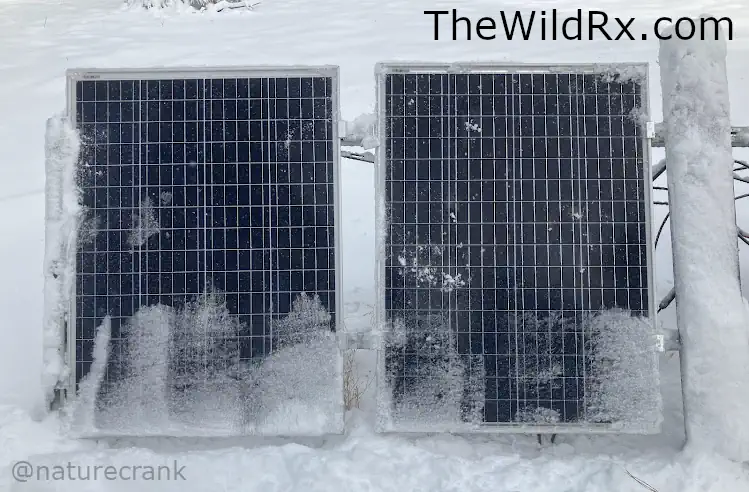
- Solar timing: Clear your panels of snow early. Even if the batteries are too cold to charge at 8:00 AM, the solar gain can power your heating pads so that by 11:00 AM, the batteries are warm enough to accept a charge.
- Thermometers: Get a bluetooth thermometer to help you monitor the inside temps. I currently live year-round in my RV, so I have indoor and outdoor ECOWITT wifi thermometers so that I can monitor my RV abroad. I can also remotely connect to my equipment if needed with Victron.
Common winter boondocking mistakes to avoid
- Leaving the inverter on: Inverters have a “standing draw” (idle power) that can waste 15–20Wh per hour. In winter, turn it off unless you are actively using AC power.
- Heating the air, not the battery: Don’t just stick a heater in the room; ensure the heat is conductively applied to the battery case for maximum efficiency.
- Ignoring the “Cold Soak”: Remember that a battery takes hours to warm up. If it’s been 10°F all night, the battery will still be frozen long after the air outside reaches 40°F.
- Forgetting the BMS “Wake-up” call: In extreme cold, some BMS units go into a deep “sleep” or “protect” mode that shuts down output entirely. You may need a 12V voltage trigger—like a portable power station or a dedicated battery jump starter—to “wake up” the BMS before it will accept a charge or provide power again.
Quick winterization checklist for your electrical system
| Task | Why it matters |
| Seal wire entry points | Prevents “drafts” from pulling heat out of the battery box. |
| Set low-temp cutoffs | Ensure your solar app is set to “Disable Charge” below 32°F. |
| Check heater draw | Run your pads for one hour to see exactly how many Ah they use. |
| Clean solar panels | Even a thin layer of frost can drop solar output by 90%. |
Frequently asked questions
Have your batteries ever ‘locked you out’? There is nothing quite like waking up to a beautiful snowy morning only to realize your BMS has shut down charging and your solar is sitting idle.
Which battery brand are you running, and how does its low-temp protection actually perform in the real world? Have you found a heating pad or a Bluetooth thermometer that you swear by? Drop a comment and help a fellow boondocker avoid the ‘Chinese junk’ traps!
Discover more from The Wild Rx aka NatureCrank™
Subscribe to get the latest posts sent to your email.