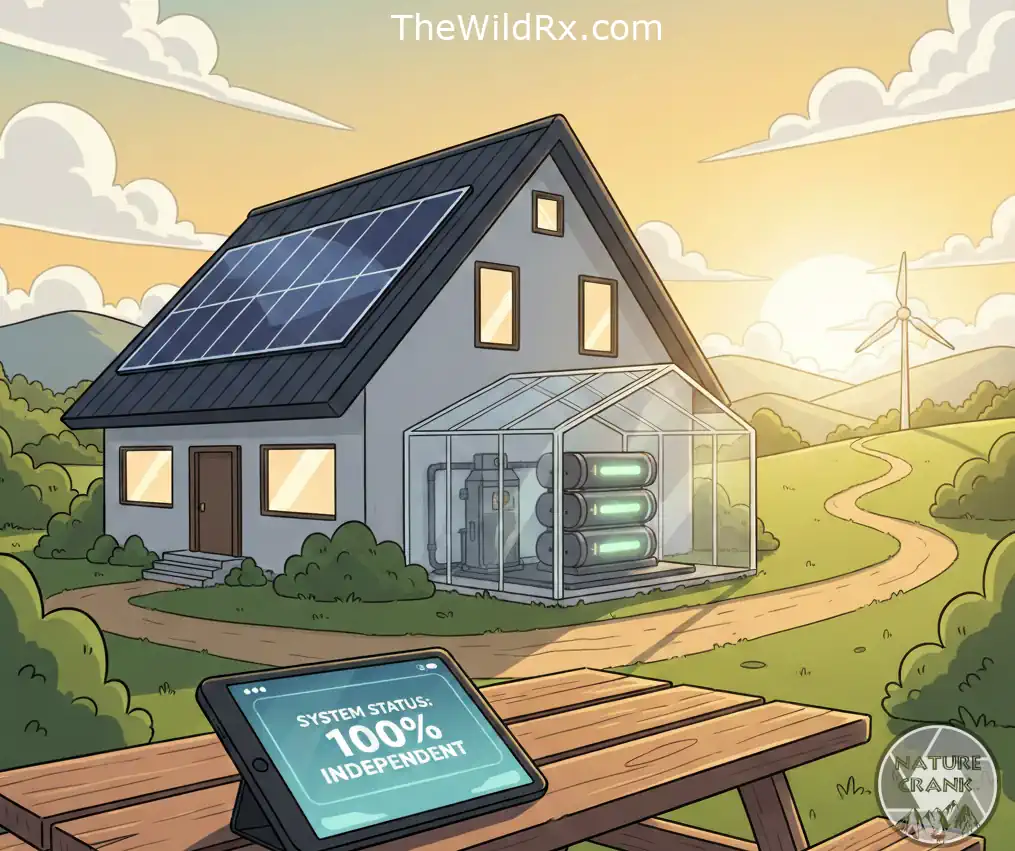
True independence in 2026 requires a balance of high-tech hardware and legal foresight.
Hey there! Quick note: As an Amazon Associate, I earn from qualifying purchases through affiliate links in this post—at no extra cost to you. Your support helps fuel my passion for sharing great content—thanks a bunch!
In 2026, the dream of energy independence is more popular than ever. With fluctuating energy costs and a growing desire for sustainability, many homeowners are asking: Is it actually legal to flip the switch and go entirely off-grid?
Is off-grid living legal in 2026? Yes, off-grid living is legal in all 50 states. However, local building codes, 2026 mandatory grid-tied mandates, and “minimum standards of care” laws in states like FL, CA, and AL may require a physical utility connection for a home to be legally occupied.
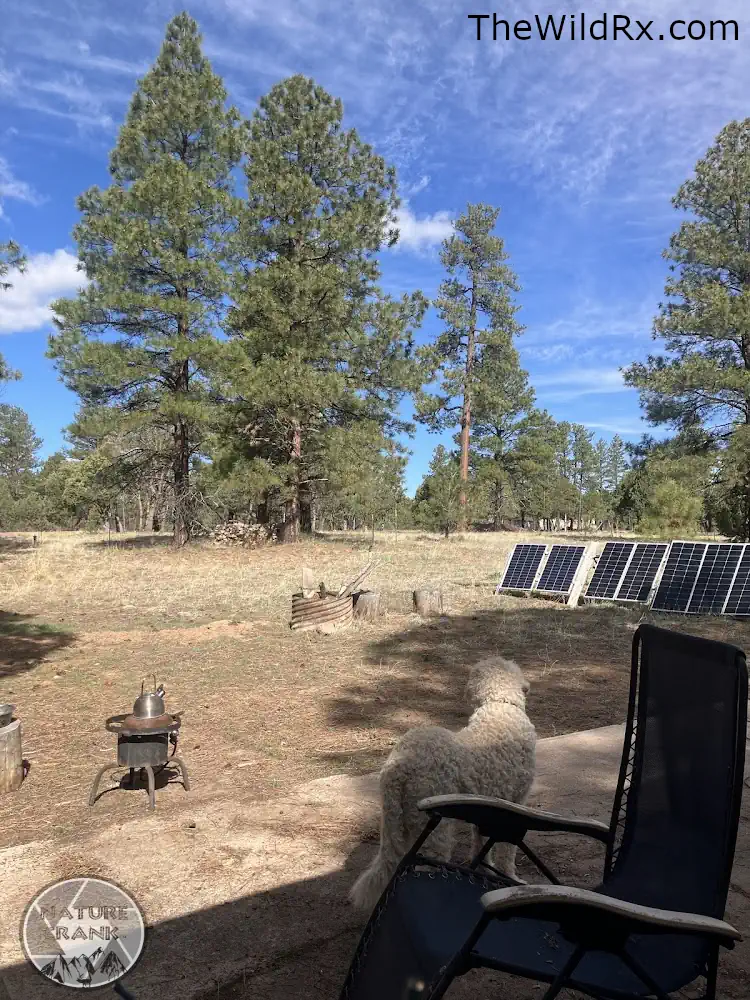
My backup panels deployed when I briefly worked at a summer camp. Currently, I’m on private land.
The term solar grid-tied requirements refers to local or state regulations that mandate a physical connection to the public utility infrastructure. Even if you produce 100% of your own power, some jurisdictions require a “hookup” for a home to be considered habitable.
Key updates for 2026:
Mandatory solar for new builds: Following California’s lead, several more states now require all new residential constructions to have active solar installations or “solar-ready” infrastructure.
The 25D tax credit expiration: A major shift occurred on January 1, 2026. The Section 25D Residential Clean Energy Credit (which gave a 30% credit for homeowner-owned systems) has expired. You can still claim this on your 2025 taxes due in April 2026 but new 2026 projects are ineligible unless leased.
The lease “loophole” (Section 48E): While you can no longer claim a 30% credit for systems you buy outright in 2026, third-party owned systems (leases and PPAs) still qualify for the 30% credit through 2027.
Certificate of occupancy: In high-density urban zones, disconnecting from the grid can lead to a revocation of your occupancy permit if your alternative system doesn’t meet specific municipal “continuous power” reliability standards.
Most off-grid friendly states 2026: Ranked
Navigating off-grid regulations varies wildly by state. While some states offer total freedom, others prioritize grid stability and safety through stricter mandates. This chart ranks states in an off-grid score of 1-10 with 10 being the most friendly.
Tier
States
Off-grid score (1-10)
Why this ranking?
The gold standard
AK, TN, TX, ID, NM, MO
9-10
High rural autonomy. Many counties have “no building codes” and encourage rainwater harvesting.
Highly accommodating
WA, OR, CO, MT, WY, AZ, KY, AR, AL
7-8
Excellent solar/wind resources. Colorado has strict water laws, but relaxed zoning in rural counties.
Generally legal, but require rigorous permitting for septic and solar. Florida has “minimum utility” battles in cities.
Regulatory hurdles
MI, WI, IL, IN, OH, PA, VA, WV, MD, DE, LA, MS
3-4
High frequency of mandatory grid-tied codes in suburban areas. Strict septic and greywater enforcement.
The “red tape” zone
CA, NY, MA, NJ, CT, RI, HI
1-2
Extremely high land costs and strict “Title 24” style energy mandates. Off-grid is often only legal in the most remote areas.
The “Mandatory Connection” trap: Three major hurdles
While “going off-grid” sounds like a simple choice, these three legal mechanisms are often used to keep homeowners tied to the utility.
1. The “Continuous Service” requirement (Alabama & Mississippi)
In parts of Alabama (specifically within certain Alabama Power service areas) and Mississippi, local ordinances may define a “habitable structure” as one with a continuous, reliable power source connected to the public utility.
The Issue: Even if your solar system is perfect, if the local code says a home must have an active utility account to be considered “safe,” you can be fined or evicted for disconnecting.
Why it happens: This is often framed as a public safety issue—ensuring that smoke detectors and HVAC systems always have a “guaranteed” power source.
2. The “Certificate of Occupancy” leverage (Florida & Urban Areas)
This is the most common legal hurdle. To live in a house, you need a Certificate of Occupancy (CO).
The Issue: Building inspectors in many Florida counties (like the famous Cape Coral cases) have argued that if a home is not hooked up to municipal water or power, it is “unsanitary” or “unfit for habitation.”
2026 Shift: New 2026 building codes in states like California and New York require “Smart Electric Ready” infrastructure. This means even if you don’t use the grid, the wiring for it must be installed and inspected before you can legally live there.
3. The “Service Area” exclusivity (North Carolina & Georgia)
In North Carolina, the “Territorial Assignment” laws (NC Gen Stat § 62-110.2) give specific power companies the exclusive right to serve certain areas.
The Issue: If you build a home within 300 feet of an existing power line, the utility company may have the legal right to demand a connection fee or a “standby fee,” even if you never pull a single watt from the grid.
The “Standby Fee”: Some utilities charge $20–$50 a month just for the “availability” of power to your property line, effectively making it impossible to truly pay $0 for electricity.
The “private” gatekeepers: HOAs and insurance
Even if your state has a “gold standard” ranking, two private entities can still derail your off-grid plans: Homeowners Associations and Insurance Providers.
1. The HOA aesthetic & utility rule
In many modern developments, Homeowners Associations (HOAs) have more day-to-day power over your property than the local government.
The Conflict: While many states have “Solar Rights” laws that prevent HOAs from banning solar panels, these laws rarely protect your right to disconnect.
The Constraint: An HOA may require you to maintain an active utility account to ensure the neighborhood’s “uniformity of service” or to prevent property values from dropping due to perceived “unconventional” living setups.
2. The insurance “gap”
In 2026, finding a homeowner’s insurance policy for a 100% off-grid property has become a significant challenge.
The Master Electrician Mandate: Most major carriers now require a “Letter of Certification” from a licensed Master Electrician confirming that your system meets NEC 2026 and UL 9540A standards before they will issue a policy.
Fire Risk Concerns: Without a professional install and a “Smart Electric Ready” inspection, insurers view self-managed battery arrays as a high fire risk. Going DIY might save you money on labor, but it could make your home uninsurable—and therefore ineligible for a mortgage.
The “social” hurdle: CPS and off-grid parenting
Beyond building inspectors and insurance agents, off-grid families in 2026 face a third, more personal gatekeeper: Child Protective Services (CPS). We’ve all heard the horror stories. I had some friends who went off-grid and faced periodic inspections after someone called CPS. It can and will happen. Many CPS workers are honest, while others are not. Always protect you assets.
The “minimum standard of care” trap
CPS investigators are trained to look for “environmental neglect.” In many jurisdictions, an investigator’s checklist includes things like “reliable lighting,” “climate control,” and “access to potable water.”
The risk: If your system fails or is being repaired when an investigator visits, a lack of running water or electricity can be legally classified as a “failure to provide a safe home.”
The “harassment” factor: Anonymous tips from neighbors or disgruntled family members about your “unconventional” lifestyle are often enough to trigger a mandatory home inspection.
Real-world examples & safety
The 2026 defense: To protect your family, keep a “Redundancy Log.” Showing an investigator that you have a 48-hour battery backup, a backup generator, and a certified water filtration system (like a Berkey or UV system) can provide the “proof of stability” needed to close a case.
While popular in the off-grid community for decades, Berkey water systems became a major legal liability in 2025. In the ongoing federal case New Millennium Concepts, Ltd. v. EPA (5th Cir. 2025), the EPA reclassified Black Berkey elements as “pesticides” rather than “devices” under the Federal Insecticide, Fungicide, and Rodenticide Act (FIFRA).
The Legal Risk: Because Berkey filters are not certified by the NSF or ANSI for microbiological purification (due to the company’s refusal to share “trade secret” information with regulators), an investigator can argue that a home using only a Berkey lacks a “certified potable water source.”
The “lack of heat” precedent: In colder states like Michigan or Maine, CPS has historically intervened in homes where wood stoves are the only heat source if they aren’t properly permitted or if the wood supply is deemed “inadequate” for a child’s safety.
For example, Mich. Admin. Code R. 400.1941 requires that wood stoves and solid-fuel appliances be inspected and approved by a mechanical inspector. Historically, if an off-grid system is found to be unpermitted or if the fuel supply is deemed “inadequate” for a child’s safety during a cold snap, CPS can cite “environmental neglect” as a reason for intervention.
The “sanitation” triggers: A common real-world trigger for CPS involvement is the use of unpermitted composting toilets or a lack of pressurized running water. For instance, the California DCFS Policy 1200-501.00 explicitly defines “unhealthy living conditions” to include a lack of utilities or a safe and sanitary environment for human waste.
If a local health department determines that an off-grid waste system (like a DIY “Lovable Loo” or an uncertified composting toilet) is “unsanitary,” CPS can use that finding to argue the home is unfit for children, regardless of the parent’s sustainable intentions.
The “Cape Coral” ripple effect: A defining moment for off-grid rights was the case of Robin Speronis in Cape Coral, Florida, who was evicted after a magistrate ruled that while she could generate her own power, she was legally required to be hooked up to the city water system to meet “minimum maintenance” codes.
This case set a chilling precedent: even if your system works, the absence of a grid connection can be used to declare a home “uninhabitable.” This logic has trickled down into CPS handbooks, where ‘standard’ now equals ‘safe’—and anything else is a red flag.
Pros and cons of disconnecting from the utility grid
The advantages
Total energy independence: You are immune to utility price hikes and rolling blackouts.
Environmental impact: Utilizing off-grid solar kits and wind power significantly reduces your carbon footprint.
Long-term savings: Once the initial investment is recouped, your monthly energy bill is $0.
The challenges
Upfront costs: High-quality lithium-ion battery storage systems and solar arrays can cost between $25,000 and $60,000.
Maintenance: You are your own utility company. If the power goes out at 2:00 AM, you are the repairman.
Waste management: Going off-grid often requires navigating septic system requirements and composting toilet laws.
The 2026 off-grid solar hardware checklist
To meet NEC 2026 and local safety standards, your system must utilize certified equipment. “Cheaping out” can result in failed inspections or loss of home insurance.
UL 9540A certified batteries: This is the current gold standard for 2026. Batteries must pass rigorous “thermal runaway” testing to be legally installed in or near residential structures.
Rapid shutdown devices (MLPE): Required by NEC 690.12. This allows first responders to de-energize your roof array instantly during an emergency.
Smart inverters (IEEE 1547-2018): Even if you are off-grid, many counties require “smart” inverters capable of grid-support functions for future-proofing and safety.
Power control systems (PCS): A major breakthrough in the 2026 NEC is the formal recognition of power control systems (PCS) for load calculations. New 2026 code allows for smaller panelboards if a PCS is used to manage loads automatically, saving you thousands on service upgrades.
The old way: Adding solar and batteries often forced a “main service upgrade,” costing homeowners thousands in utility fees and hardware.
The 2026 way: New code allows for smaller, existing panelboards to remain in place if a PCS is used to manage power flows. By actively preventing overloads in real-time, the PCS eliminates the need for oversized copper and massive panels, potentially saving you $3,000 to $5,000 on your off-grid transition.
Why efficiency matters: The “Thermal Trap”
When choosing your 2026 hardware, don’t just look at the wattage; look at the conversion efficiency. This isn’t just a nerd stat—it is a safety metric. In an off-grid setup, any energy that is “lost” during conversion doesn’t just disappear; it turns into heat.
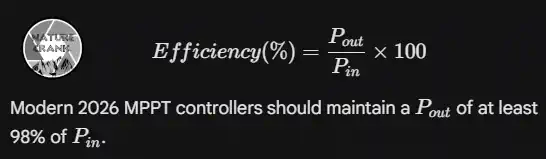
The Formula for System Health:
To verify your system is performing to manufacturer specs and not overheating, you can calculate the efficiency:
Technical note: Efficiency is calculated by comparing power output to power input:
However, keep in mind that “real-world” efficiency can dip if the unit lacks proper ventilation, as heat increases internal resistance.
Why this is your “Early Warning System”:
Internal resistance: As temperatures rise due to poor ventilation, the “internal resistance” of your batteries and inverters increases. This creates a feedback loop: higher resistance leads to more heat, which leads to lower efficiency.
The insurance connection: If your “Redundancy Log” shows a steady dip in efficiency over three months, it’s a red flag that a component is failing. In the eyes of a 2026 insurance adjuster, ignoring a 15% drop in efficiency is “negligent maintenance.”
Ventilation is key: Most UL 9540A-certified batteries require specific clearance for airflow. If you “closet” your tech to save space, your real-world efficiency will plummet, and you risk triggering a “thermal runaway” sensor that could shut your whole house down automatically.
Pro Tip: When an inspector or CPS worker asks how you know your home is “safe,” point to your efficiency logs. A system running at 95% efficiency is a system that isn’t exactly a fire hazard.
5 Steps to go off-grid legally in 2026
Verify zoning ordinances: Before buying land, ensure there are no “minimum square footage” or “mandatory utility hookup” laws.
Audit your water rights: In states like Colorado or Utah, rainwater collection laws are strict. Ensure you have the legal right to harvest water.
Secure electrical permits: Even for off-grid systems, your wiring must meet theNational Electrical Code (NEC) to pass safety inspections.
Plan for waste: Research local health department codes regarding greywater systems and septic tanks.
Maximize incentives: Since the 25D tax credit has expired for owners, look into state-specific equipment rebates or consider a “prepaid lease” to capture the Section 48E credit.
Frequently asked questions (FAQs)
No, it is not illegal. However, certain actions associated with off-grid living—like failing to provide “potable water” or “safe sewage disposal”—can lead to a home being declared “unfit for human habitation.”
In some high-density urban areas, yes. City ordinances may require homes to be connected to the grid to ensure they meet basic safety and sanitation standards. Always check your county zoning laws first.
Yes, but most states have transitioned to Net Metering 3.0, which significantly reduces the credit you receive for sending power back to the grid. This makes high-capacity battery storage essential for both off-grid and hybrid users.
Almost always. Even if you are not connecting to a utility, local building departments require permits to ensure the structure (your roof or ground mount) can handle the weight and that the electrical work is fire-safe.
True independence isn’t found in a single battery or a tax loophole; it’s found in the peace of mind that comes from a home that is truly your own. While the 2026 landscape is filled with new hurdles, those who approach the transition with both technical precision and legal foresight will find that the freedom of life off the grid is well worth the effort.
What’s the “Off-Grid Vibe” in your county? As we’ve seen, the laws in 2026 can change the moment you cross a county line. Whether you’re in a “Gold Standard” state like Tennessee or fighting the “Red Tape” in California, your real-world experience is the best resource for other readers.
Have you faced a “mandatory hookup” fee or a surprise inspection lately? Drop your state and your experience in the comments below—let’s help each other map out the true 2026 off-grid landscape!
About the author
Mik is a veteran, educator, and writer who has lived off-grid and nomadic since 2020. His perspective is shaped by a diverse career in both for-profit and non-profit management, as well as years of experience as an instructor in biology, psychology, health, and ESL.
By blending his formal studies in counseling and science with the practical realities of life on the trail, Mik provides a unique, grounded approach to nature-based healing. When he isn’t documenting the natural world through wildlife photography and geology, he is exploring the intersection of scientific research and the restorative power of the outdoors.
To provide the best experiences, we use technologies like cookies to store and/or access device information. Consenting to these technologies will allow us to process data such as browsing behavior or unique IDs on this site. Not consenting or withdrawing consent, may adversely affect certain features and functions.
Functional
Always active
The technical storage or access is strictly necessary for the legitimate purpose of enabling the use of a specific service explicitly requested by the subscriber or user, or for the sole purpose of carrying out the transmission of a communication over an electronic communications network.
Preferences
The technical storage or access is necessary for the legitimate purpose of storing preferences that are not requested by the subscriber or user.
Statistics
The technical storage or access that is used exclusively for statistical purposes.The technical storage or access that is used exclusively for anonymous statistical purposes. Without a subpoena, voluntary compliance on the part of your Internet Service Provider, or additional records from a third party, information stored or retrieved for this purpose alone cannot usually be used to identify you.
Marketing
The technical storage or access is required to create user profiles to send advertising, or to track the user on a website or across several websites for similar marketing purposes.